
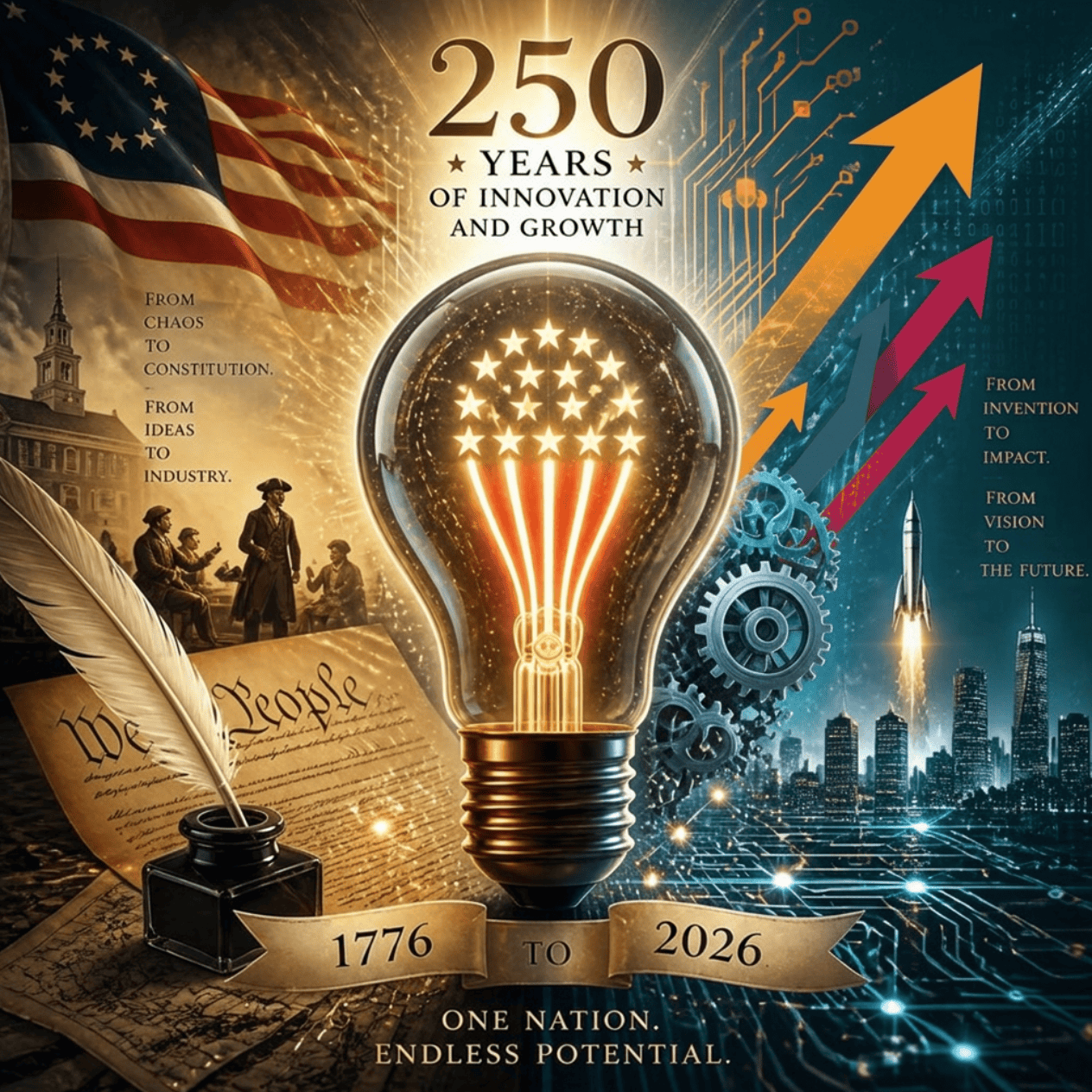
As our country marks 250 years since a small group of colonists looked at England and decided the old playbook no longer applied, I’ve been reflecting on my own career and how many of my most creative solutions were born out of similar chaos. What had worked before stopped working for the issue at hand. Sound familiar? It should. It’s the American story on repeat.
That pattern showed up in my own work, too. United around a common goal to find solutions, we brought together diverse teams to attack the issue from different angles, not unlike the improbable coalition of farmers, merchants, and printers who somehow turned disagreement into a Declaration. Do you know that old metaphor of turning the coffee cup to examine the problem from every angle? Well, we went even further. We questioned whether the coffee cup was really a coffee cup. That’s not disrespecting the cup; it’s the same instinct that turned thirteen colonies into an idea nobody had fully built before.
None of this happens without a willingness to sit in uncertainty first. Jeff DeGraff wrote: “Growth requires that we move out of the known and towards the unknowable, experimenting and revising as we go.” Two hundred fifty years of amendments, reinventions, and hard-won corrections say he’s onto something. Growth is never easy; we like the comfort of our known space. That’s often exactly why it takes chaos to get us moving.
So let’s sit with that word for a second. Invite chaos in? Yes. Chaos has gotten a bad rap over the years, but it hasn’t earned it. If we look back to Ancient Greece (courtesy of Merriam-Webster), “chaos was originally thought of as the abyss or emptiness that existed before things came into being.” That’s not destruction, that’s the blank page before a nation, before an invention, before your next best idea. This is a reframe I can work with. You might want to post that definition near your desk, right next to a copy of the Preamble, both remind you that “forming a more perfect union” is a verb, not a finished state.
Once you’ve made peace with the emptiness, the real work can begin. Moving past chaos and into creativity and innovation requires that time of stillness when you let go of the known. Your experience and knowledge aren’t wasted; they got you to this point. But it’s time to go further. It’s an opportunity to be like Edison, who viewed failure as an opportunity to learn, racking up 10,000 learning points on the way to the lightbulb. He had a growth mindset and a great team. America, at 250, is still assembling hers. What will you bring to the table?